
ZK-Proven Derivatives Incentives: Rewarding Stability, Not Just Volume
Volume-based rewards in derivatives protocols have a specific failure mode that makes them worse than neutral: they don't merely fail to distinguish good behavior from bad, but even actively subsidize the bad.
A trader running high-frequency, high-leverage speculation generates enormous volume. So does a hedger carefully managing downside risk on a long spot position. The latter provides vastly better value to the protocol, yet volume-based rewards pay both the same rate per dollar traded. In practice, they often pay the speculator more, because the speculator trades more. The hedger, who provides something genuinely useful for the protocol and for market stability, gets no additional recognition for doing so.
This creates a race to the bottom. Protocols optimizing for TVL and volume metrics attract the traders who are best at generating volume metrics. Those traders tend to amplify volatility, increase liquidation cascades, and extract from the protocol during stress periods rather than stabilize it. The hedgers and risk-conscious traders who contribute to the health of the ecosystem find their contributions priced identically to behavior that actively undermines it, and many go elsewhere
The reason this pattern persists is the same reason lending protocols are stuck on TVL rewards: smart contracts cannot evaluate trading purpose. Distinguishing genuine hedging from speculation requires analyzing position context: correlation with spot holdings, sizing relative to underlying exposure, behavior across multiple positions over time, leverage usage patterns, and so on. That analysis cannot run inside a contract. It requires querying indexed historical data using logic that would be computationally prohibitive onchain.
Space and Time's Proof of SQL is the infrastructure that makes purpose-aware derivatives incentives computable and verifiable onchain.
How Proof of SQL Works
Space and Time indexes your derivatives protocol's onchain activity into a queryable database: every position open and close, every liquidation event, every settlement, leverage usage, position duration, and size relative to other onchain holdings. You write SQL queries that analyze this data to calculate what each trader is actually doing and how it affects market health.
Those queries run offchain, where complex multi-variable analysis is computationally feasible. Proof of SQL then generates a cryptographic proof that the query ran correctly against the exact data it claims to have used. Your reward contract receives the result and its proof, verifies the proof onchain, and distributes rewards accordingly.
No outside intermediary is making judgment calls. The criteria are encoded in SQL, applied consistently, and verified mathematically. Any trader can audit exactly how their reward was calculated.
What Intelligent Derivatives Incentives Actually Recognize
Genuine hedging activity. Hedging has identifiable characteristics in onchain data. Positions that are directionally opposite to spot holdings, sized proportionally to the underlying exposure, and held for durations consistent with risk management rather than speculation leave a distinct footprint. SQL lets you define those characteristics precisely and score traders against them. Protocols can reward hedging activity at a premium because they can now prove, onchain, which activity qualifies.
Risk management quality. Sophisticated risk management shows up in behavior over time: consistent use of appropriate leverage, stop-loss discipline, position sizing relative to protocol liquidity, behavior during volatile periods. A trader who has never been liquidated, consistently operates within conservative leverage bands, and reduces position size during market stress is contributing to protocol stability in a meaningful way. That contribution can now be quantified and rewarded.
Stability-enhancing vs. destabilizing patterns. Not all trading volume affects the market the same way. Trades that tighten spreads, provide liquidity at stressed moments, and reduce one-sided positioning contribute to market health. High-frequency leverage cycling that increases volatility and liquidation risk does the opposite. These patterns are visible in indexed data and distinguishable in SQL. Incentive programs can now price them differently.
Long-duration position commitment. Traders who maintain positions over extended periods rather than cycling in and out provide more stable market structure than those generating equivalent volume through rapid turnover. Time-weighted position scoring, when combined with behavior analysis, gives protocols a way to reward the kind of participation that makes markets function better.
How the System is Structured for Stability-Focused Derivatives Incentives
The architecture has three layers that handle distinct responsibilities.
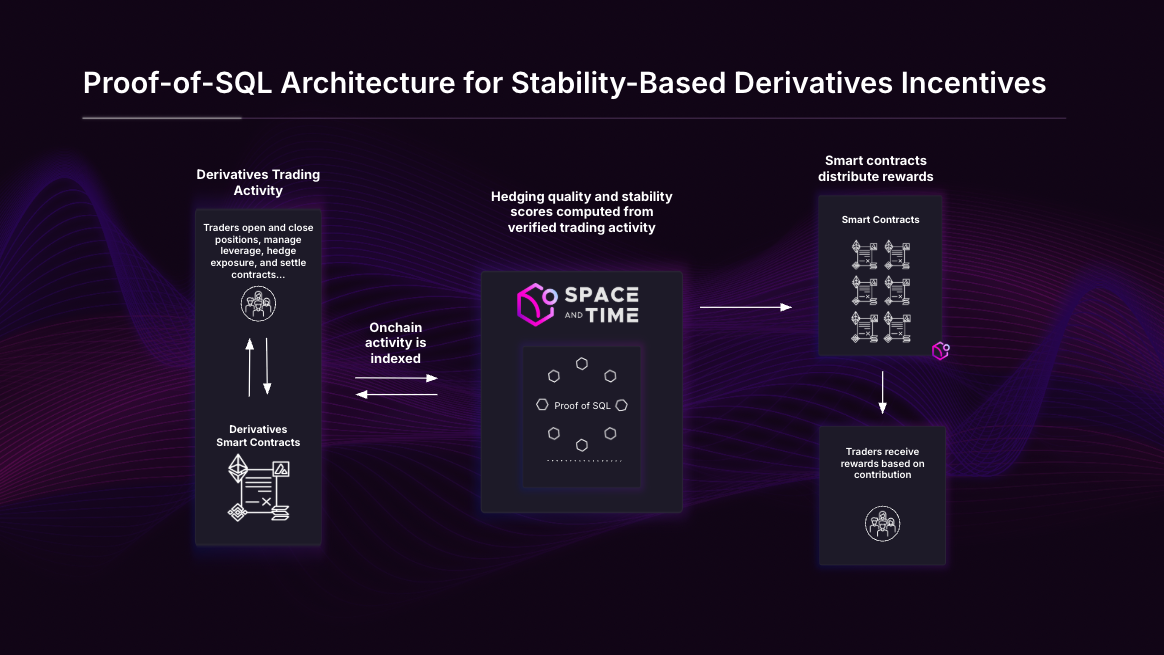
The indexing layer ingests your derivatives protocol's onchain activity and makes it queryable. You configure this through the Space and Time Studio by selecting the contracts and event types to monitor, e.g., perpetual contracts, options protocols, futures systems, position events, liquidation triggers, settlement activities. The indexer normalizes data across contract types and tracks activity continuously.
The query layer is where trading purpose and risk quality assessments live. You write SQL that defines hedging indicators, leverage thresholds, stability contribution metrics, and gaming-detection logic. Proof of SQL runs those queries and returns results with cryptographic proofs. The sophistication of your incentive program is bounded solely by what you can express in SQL.
The contract layer receives query results with their proofs, verifies onchain that the computation happened as specified, and executes reward distribution. The verification is onchain. There is no need for an administrator to assert that the analysis was done correctly; instead, the proof guarantees it.
Three Steps to Deploy Intelligent Onchain Derivatives Incentives
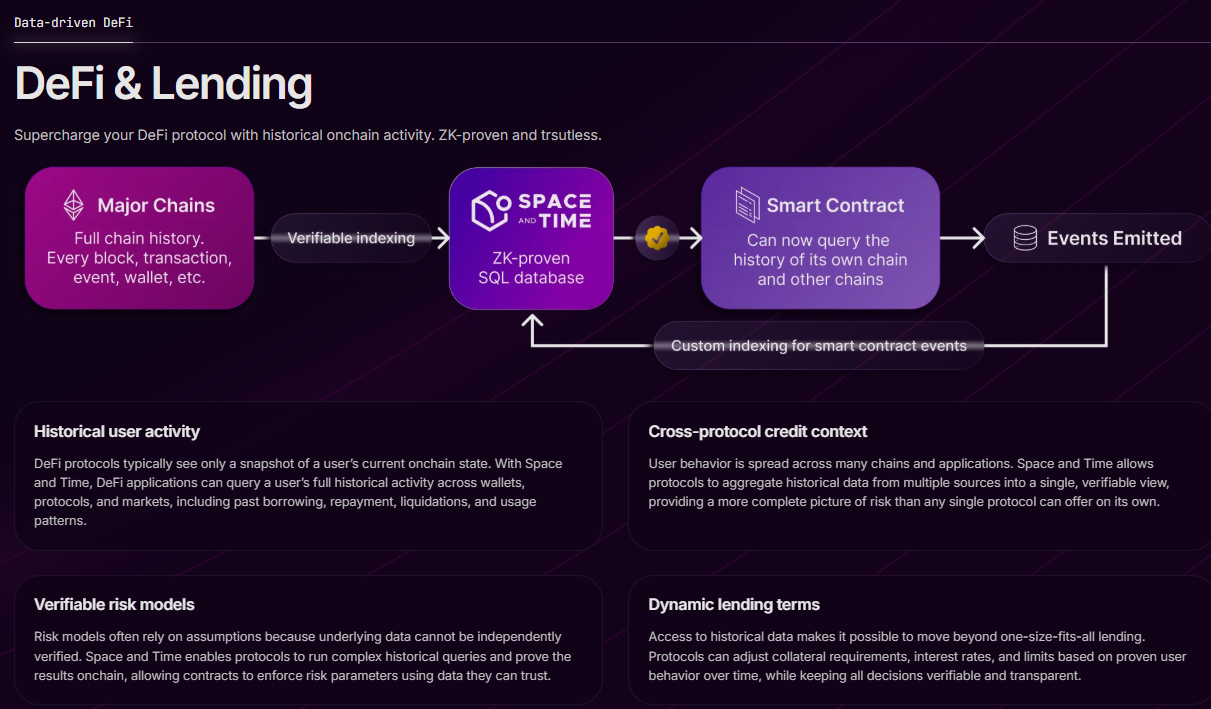
Implementing stability-focused derivatives incentives using Space and Time requires only three simple steps to transform volume-based rewards into intelligent, protocol health-optimized onchain systems:
Step 1: Index the Right Onchain Data
Select the contracts and events to index: your perpetuals, options, and futures contracts along with the position, liquidation, and settlement events that provide behavioral signals. Submit these through the Space and Time Studio, and the indexer begins tracking.
Step 2: Configure the Onchain Smart Contract Logic
Configure the reward contract with a SQL query that scores traders on hedging quality and risk management behavior, and with the reward logic that translates those scores into distribution. This is where your protocol defines what it values and wants to incentivize.
Step 3: Deploy and Activate Onchain Stability Intelligence
Deploy the contract. It connects to Space and Time's query infrastructure and begins operating. Distribution is from that point forward based on verified behavioral analysis.
Once deployed, your onchain derivatives incentive system operates autonomously, adapting to market conditions and participant behavior, continuously optimizing reward distribution for maximum market stability while maintaining cryptographic security and transparency through onchain execution.
For complete technical details on implementing onchain Proof of SQL smart contracts, including code examples and deployment guides, see the full onchain deployment documentation.
Why Derivatives Protocols Need This More Than Most
Derivatives markets are where leverage lives. The feedback loops between incentive design and systemic risk are tighter here than in spot trading or lending. A protocol that rewards volume without regard to quality isn't just leaving value on the table; it’s actively funding the behavior most likely to cause a liquidation cascade that can damage the entire ecosystem.
The protocols that will build durable derivatives markets are the ones that can measure what actually contributes to stability and properly incentivize it. Volume was a proxy for contribution when nothing better was measurable. Proof of SQL makes that better measurement possible. The protocols that use it first will attract the traders they actually want: hedgers, risk-conscious participants, long-duration position holders. The ones that don't will keep competing for mercenary volume and wondering why their ecosystems feel fragile.
ZK-proven derivatives incentives are part of our broader Trustless Stablecoin Rewards framework.
About Space and Time:
Space and Time provides the onchain intelligence infrastructure that enables sophisticated, stability-focused derivatives incentive systems. Our Proof of SQL technology helps derivatives protocols build intelligent reward programs that automatically recognize hedging value and risk management quality while promoting market stability over raw volume metrics.
