
Onchain vs. Offchain ZK Proof Verification: What Actually Changes?
Zero-knowledge proofs have become a central building block of blockchain infrastructure. They power rollups, privacy protocols, and increasingly, the verification of offchain computation. But there is a practical architectural question that every team building with ZK technology must answer: should you verify proofs inside a smart contract onchain, or should you outsource verification to an offchain aggregator that posts a single proof to the chain? The answer shapes your application's cost structure, latency, trust model, and composability.
Option 1: Verifying ZK Proofs Directly Inside a Smart Contract
In this model, a ZK proof is generated offchain and submitted directly to a verifier contract on the EVM. The smart contract runs the verification algorithm, confirms that the proof is valid, and then uses the result in its execution logic. This is the approach used by ZK rollups like ZKsync and by protocols that need to consume verified data onchain.
The advantages are straightforward. The verification is fully onchain, which means it inherits the security and liveness guarantees of the underlying blockchain. There is no trust assumption beyond the blockchain itself. Any smart contract on the same chain can reference the verified result, making it composable with the rest of the DeFi ecosystem. The verification is publicly auditable: anyone can check that the proof was valid.
The disadvantages are primarily economic. EVM verification consumes gas, and depending on the proof system, this can range from roughly 100,000 gas for optimized schemes to several hundred thousand or more for complex proofs. If your application requires frequent proof submissions, the gas costs accumulate and can become prohibitive. There is also a design constraint: the verifier contract must be implemented for a specific proof system, and changes to the proving scheme require redeploying the verifier.
Option 2: Offchain Aggregation with a Single onchain Proof
The alternative model adds an intermediary layer. Instead of verifying each proof individually onchain, an offchain aggregator collects multiple proofs, batches them, and generates a single aggregated proof that is posted to the chain. The onchain cost is amortized across all the proofs in the batch.
This approach is most commonly seen in rollup sequencers and certain data availability solutions. The economic benefit is clear: if you are batching hundreds or thousands of proofs into a single onchain verification, the per-proof cost drops dramatically. For high-throughput systems, this makes ZK verification economically viable at scale.
The tradeoffs, however, are considerable. Batching introduces latency; individual proofs must wait for the batch to be assembled and the aggregated proof to be generated before the result is finalized onchain. The aggregator itself is a new entity in the trust model; while the cryptographic soundness of the ZK proof system means the aggregator cannot forge proofs, it can censor them, delay them, or choose which proofs to include in a batch. If the aggregator goes offline, proof submission halts until a replacement is available. Finally, composability is also affected; until the batched proof is posted, other onchain contracts cannot reference the result.
Where the Tradeoffs Matter Most
The right choice depends on your application's requirements. For applications where latency matters, such as DeFi protocols making real-time decisions based on verified data, onchain verification is typically preferable. The cost per verification is higher, but the result is immediately available and composable. For applications where throughput matters more than immediate finality, such as rollup state updates or periodic compliance attestations, offchain aggregation is more economical.
However, there is also an emerging middle ground: some systems perform verification via a decentralized oracle network rather than directly on the EVM. In this model, a set of oracle nodes verifies the proof offchain and relays the result onchain through a consensus mechanism. This reduces gas costs as well as latency compared to full onchain verification while preserving decentralization compared to a single aggregator.
How Space and Time Handles Proof Verification
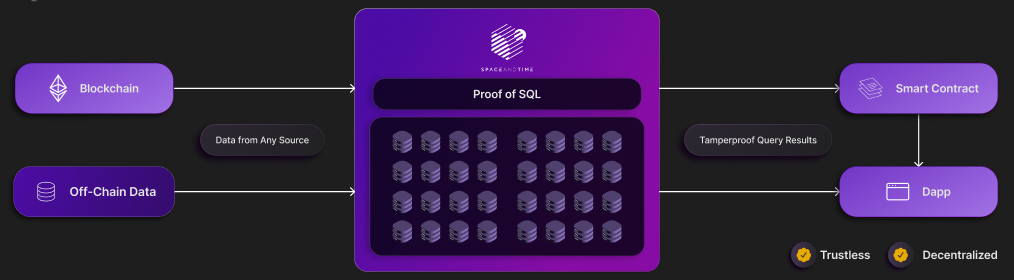
Space and Time's architecture is designed to support both onchain and offchain verification, adapting to what each use case demands. When a developer queries SXT using Proof of SQL, the Prover node generates a ZK proof that the SQL query was executed correctly over tamperproof data. This proof can then be verified in multiple ways.
For direct onchain verification, SXT has deployed ZKpay query relayer contracts on the EVM. These contracts receive the query result and the ZK proof, verify it onchain, and deliver the result to the calling smart contract via a callback. SXT is also developing a novel commitment scheme, specifically designed for database operations, that significantly lowers the gas cost of onchain verification.
For applications for which gas cost is a primary concern, SXT integrates with the Chainlink Network. In this model, Chainlink nodes verify the ZK proof offchain as part of a Chainlink Functions workflow and relay the verified result onchain. Developers who are already familiar with Chainlink can create a Functions job that queries SXT like any third-party API, but with the added assurance that the Chainlink Network has verified the ZK proof before relaying the result. This provides a consensus-based verification more cost-effective than direct EVM verification while maintaining decentralization.
The key design principle is that the proof itself remains the same regardless of where it is verified. Proof of SQL generates the cryptographic proof once, and the developer chooses the verification path that best fits their application: direct onchain verification for maximum composability and trustlessness, or Chainlink-based verification for a lower cost with a well-established decentralized relay layer.
Choosing Your Verification Strategy
For most developers, the practical guidance is to think in terms of how often one needs to verify and how urgently other contracts need to reference the result. If one’s application triggers a verified query once per user action and other contracts need to compose with the result in the same transaction, direct onchain verification is the right path. If one’s application runs periodic batch computations, such as daily settlement calculations or weekly reward distributions, and latency is less critical, offchain or oracle-based verification will effect a meaningful reduction in gas costs.
The broader trend in the industry is toward making ZK verification cheap enough that onchain verification becomes the default. As proof systems are optimized for lower onchain cost, the economic argument for offchain aggregation weakens.
Space and Time's investment in a novel, low-gas commitment scheme reflects this trajectory. Ultimately, the direction is clear: a future where verifiable data is not an exception handled offchain, but a native, seamless component of onchain applications.
