
Market Maker Proof of Reserves: Solving the Multi-Exchange Verification Problem

Market makers are the bedrock underlying crypto markets. They provide liquidity, tighten spreads, and keep order books functional across hundreds of trading pairs on dozens of exchanges. It's a business that requires significant capital, and that capital needs to live where the trading happens.
This creates a unique problem. A market maker's reserves aren't stacked neatly in one wallet. They're scattered across numerous exchange accounts, in different assets, on different platforms, in constant motion. Proving total reserves to a lender, an investor, or a counterparty using traditional tools isn’t merely difficult; it's effectively impossible to do in a way that's both complete and trustworthy.
This is the market maker Proof of Reserves problem, and it demands a different approach than what works for a single exchange proving solvency to its users.
How Market Makers Are Different
Most discussions of Proof of Reserves center on exchanges proving to depositors that customer funds are fully backed. That's an important use case, but it's a fundamentally different problem than what market makers face.
An exchange has one set of wallets holding one pool of assets that need to match one set of liabilities (customer deposits). It's a contained system. The exchange controls the data on both sides, assets and liabilities, and the challenge is mainly about proving it honestly.
A market maker's situation is inverted. Their assets are held on exchanges they don't control, spread across accounts on platforms with different APIs, different reporting standards, and different levels of transparency. The market maker can see its own balances, but proving them to an outside party requires pulling data from many independent sources and assembling it into a coherent picture.
Add to this the fact that market maker balances change constantly. Positions shift as trades execute. Funds move between exchanges to rebalance inventory. New markets are entered and old ones are exited. A snapshot of a market maker's reserves has a shelf life measured in hours, not months.
For lenders evaluating a potential loan, this fragmentation creates a fog of war. They can see pieces of the picture, maybe an API export from one exchange or a screenshot from another, but never the whole thing, never in real time, and never with confidence that what they're seeing hasn't been curated and is properly up to date.
The Cost of Being Unprovable
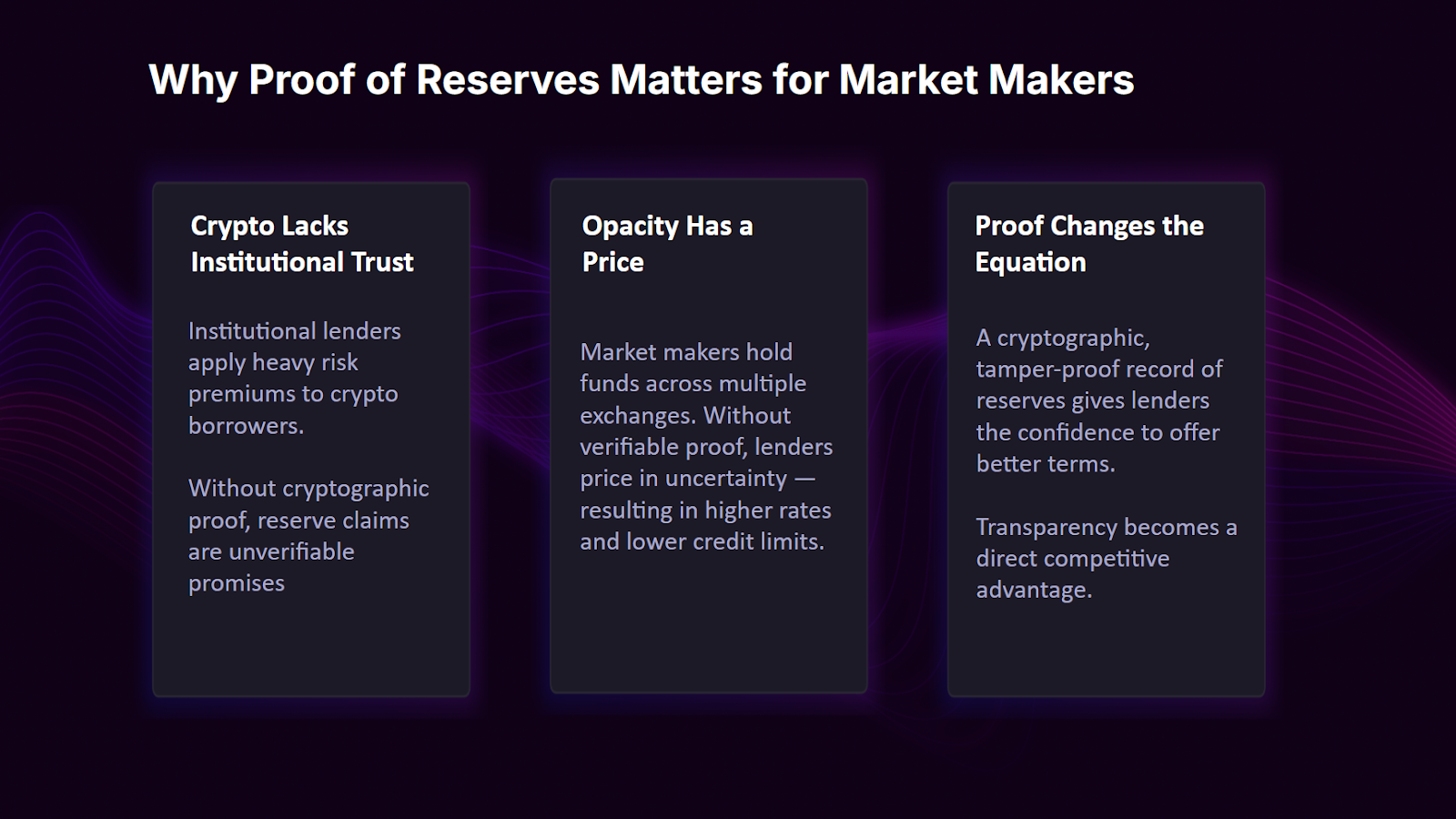
Market makers borrow heavily to fund their operations. Borrowing at scale requires demonstrating creditworthiness, and in traditional finance, that means showing what you own, what you owe, and how the two relate.
In crypto market making, the "showing what you own" part is where the system breaks down. A firm might hold $200 million across 14 exchanges, but proving that in a way a sophisticated lender finds credible is a manual, slow, and trust-dependent process. The lender has to take the market maker's word for most of it,
This uncertainty has a direct and measurable cost. Lenders apply higher risk premiums to offset what they can't verify. Loan-to-value ratios are more conservative. Credit limits are lower than the firm's actual reserves would justify. In competitive lending markets, even a small increase in borrowing costs compounds into millions annually.
There's also an opportunity cost. Firms with provable reserves can access capital faster and from a broader set of lenders. Firms that can't prove their reserves are limited to lenders willing to extend credit on the basis of reputation alone, which amounts to a shrinking pool as the institutional market continues to mature.
Why Existing Solutions Fall Short
Market makers have tried various approaches to the reserve verification problem, and each has significant limitations.
Self-reported balance sheets are the most common approach: the firm compiles its balances from each exchange and presents them in a document. The problem is obvious: there's nothing preventing the firm from inflating numbers, omitting liabilities, or presenting an otherwise curated view. No sophisticated lender treats self-reported data as sufficient.
Periodic third-party audits add credibility but suffer from the same limitations that plague all periodic attestation in crypto: by the time an audit report is finalized, the data is weeks or months old. For a market maker whose balances shift daily, a quarterly audit provides very limited assurance about the present-day state.
Exchange API access is a more modern approach in which the market maker grants the lender read-only API access to its exchange accounts. This is preferable to the aforementioned options since the data is coming directly from the source, but it creates operational headaches. Each exchange has different API formats, so lenders need to build or buy tools to ingest and normalize the data. Permission management becomes complex. And, critically, the lender still has to trust that the market maker is sharing all of its accounts, rather than just the ones with healthy balances.
None of these approaches solve the core problem: providing a unified, continuously updated, non-tamperable, and independently verifiable view of reserves across all exchanges.
The Architecture Market Makers Need
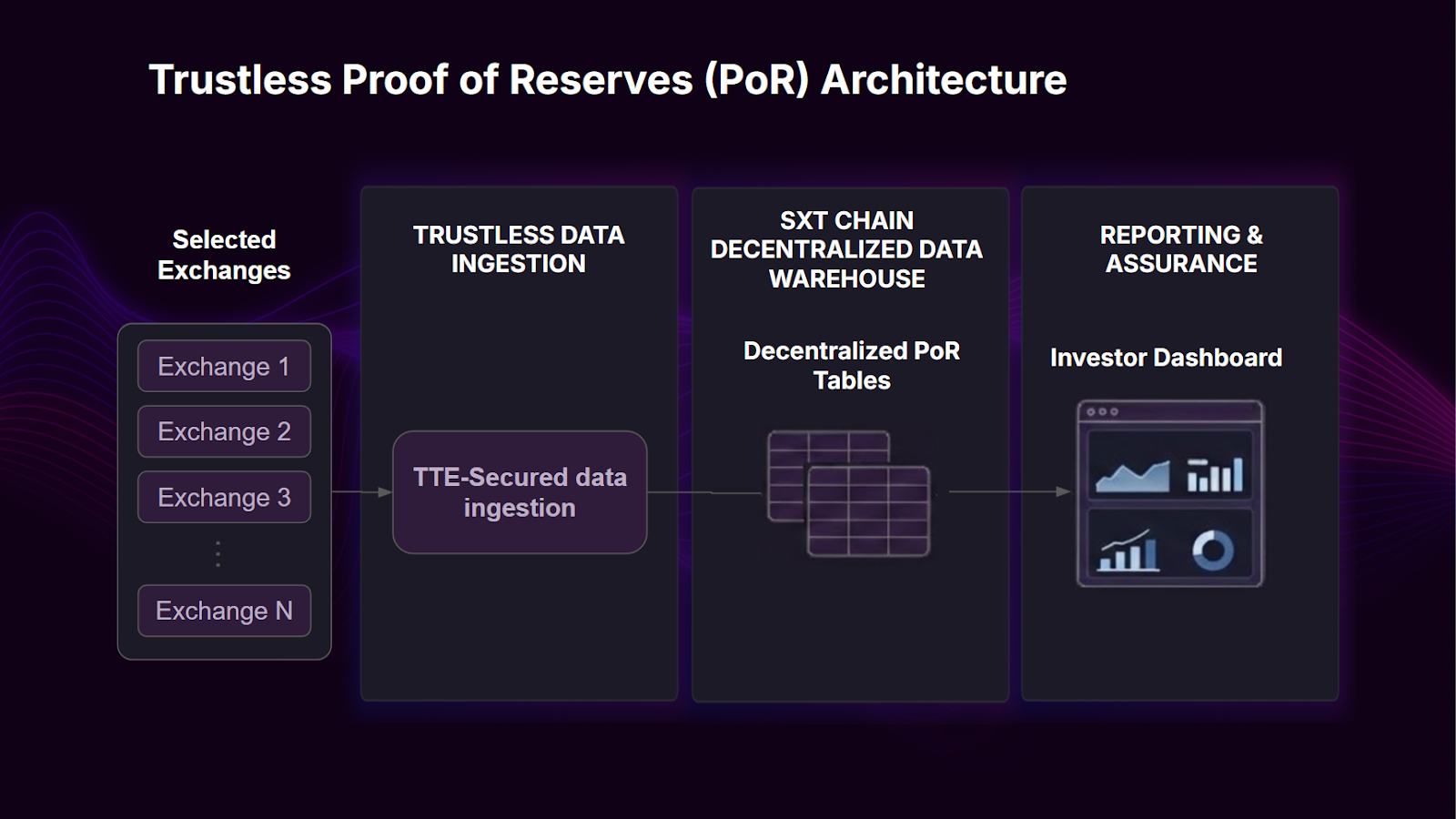
What market makers need is a system that pulls balance data from every exchange on which they hold funds, attests to that data's authenticity without human intervention, stores it in such a way that no party can alter it after the fact, and lets counterparties query and verify the aggregated picture on demand.
Space and Time's trustless Proof of Reserves solution maps each of these requirements to a specific piece of infrastructure. TEE-secured ingestion fetches and attests balance data without human involvement. SXT Chain's decentralized database stores it immutably. Proof of SQL lets anyone who queries the data receive a cryptographic proof that the result is correct. (For a detailed walkthrough of how each layer works, see our deep dive on trustless proof of reserves.)
For a market maker operating across multiple exchanges, this produces something that has never existed before: a single, continuously updated, independently verifiable, and trustworthy record of total reserves that a lender can check at any moment with cryptographic certainty.
Integrating Exchange by Exchange
A practical consideration for market makers is that their exchange footprint is large and varied. Not every exchange has the same API capabilities. Some have modern REST APIs with comprehensive balance endpoints. Others have proprietary or limited interfaces.
Space and Time's pipeline accommodates this. The solution supports phased rollout, starting with an initial set of exchanges and expanding incrementally. Each new integration is additive, extending the existing system rather than requiring a new one. A market maker can start demonstrating verifiable reserves to lenders quickly, then progressively expand coverage until the entire exchange footprint is captured in a unified view.
Protecting Competitive Intelligence
Market makers have a legitimate and urgent reason to be cautious about reserve transparency: their exchange balances reveal their market strategy.
For example, a firm that's heavily positioned on one exchange versus another is signaling where it sees opportunity. The distribution of assets across exchanges indicates which markets it's making, which pairs it's focused on, and how it's managing inventory. In a competitive industry in which edge is everything, broadcasting this information publicly could be self-defeating.
Trustless PoR handles this through layered privacy. Balance data can be encrypted at the point of ingestion, before it hits the blockchain. The onchain record contains attested, encrypted data that is verifiably authentic but unreadable without the right keys.
Lenders and approved counterparties receive decryption access through a private dashboard. They see the full picture, and every query they run comes with a Proof of SQL verification confirming that the result was computed correctly against untampered data. Everyone else can't access the granular data at all.
This solution allows a market maker to satisfy its lenders' need for transparency without handing competitors a roadmap to its strategy. Privacy and verifiability can coexist, because they're implemented at different layers of the stack.
The Lender's Perspective
It's worth considering what this looks like from the other side of the table.
A lender evaluating a loan agreement for a market maker currently faces a manual, incomplete process. They receive periodic reports in various formats, try to reconcile data from different sources, and ultimately make a judgment call about how much confidence to place in the borrower's claims. The uncertainty gets priced into the deal.
With a trustless PoR system, the lender gets a dashboard that shows the borrower's total reserves across all integrated exchanges, updated continuously, with each data point backed by a hardware attestation and stored on an immutable ledger. When the lender runs a query for total reserves, net position, or historical coverage, the result comes with a Proof of SQL verification of correctness.
This doesn't just reduce the lender's risk; it also reduces their operational cost. Instead of building internal tools to parse API exports and reconcile data from multiple exchanges, they query a single system. Instead of scheduling periodic reviews and manually tracking loan agreement compliance, they can monitor it continuously. Instead of relying on trust and judgment, they verify mathematically.
The downstream effect is that lenders who adopt this model can offer better terms with confidence, because their risk assessment is based on verifiable data rather than estimates. The savings flow both ways: cheaper capital for the borrower, lower risk for the lender.
Where This Is Heading
The market maker Proof of Reserves problem is a specific instance of a broader shift in institutional crypto: the move from trust-based to verification-based relationships. As the industry matures and traditional financial institutions continue to enter the space, the expectation of verifiable transparency will only grow.
Market makers that implement trustless PoR now are positioning themselves for a future in which it’s a requirement. They'll have established track records of continuous, verifiable reserve reporting. They'll have built the lender relationships that will come with being early to demonstrate true transparency. And they'll have a practical system that scales as they grow.
The technology is ready. Space and Time has assembled TEE-secured ingestion, SXT Chain's decentralized database, and Proof of SQL verification into an end-to-end solution that's available today.
For market makers, the question isn't whether verifiable reserves will matter. It's whether they want to be the firm that's already proving it, or the one that's still asking lenders to take their word for it.
Make your reserves continuously verifiable with trustless Proof of Reserves here
