
Dynamic Fees for DeFi: Why Fixed Pricing Is Holding Protocols Back

The Problem with Static Fees
Most DeFi protocols still price their services with fixed numbers. A decentralized exchange might charge 0.30% per swap. A lending protocol sets a base interest rate curve that barely moves. A liquidity incentive program distributes the same rewards regardless of whether a participant has been active for a year or for five minutes.
This made sense when DeFi was bootstrapping; fixed fees are simple to implement, easy to audit, and easy to explain to users. They helped protocols get off the ground quickly and build trust with early liquidity providers. But as the ecosystem has matured, the limitations of static pricing have become difficult to ignore.
The core issue is that a single number can’t capture the complexity of a real market. Volatility changes by the hour. Trade sizes vary by orders of magnitude. Some users provide consistent, long-term value to a protocol, while others extract what they can and leave. A lending rate that’s optimal on a Tuesday could be wildly mispriced by Thursday. A swap fee that works for a $500 retail trade is the wrong fee for a $5 million whale order moving through the same pool.
The result is predictable: liquidity providers get underpaid during high-risk periods and overpay for protection during calm ones. Arbitrageurs and MEV bots trade at the same cost as organic users. Loyal participants get no better deal than first-time visitors. And protocols competing for liquidity have no tool to differentiate on pricing beyond the blunt instrument of choosing a different static tier.
The Solution: Fees That Respond to Reality
Dynamic fees are the natural answer. Instead of a fixed rate on every transaction, the fee adjusts based on context: market volatility, trade size, the user’s history, liquidity depth, or any other signal the protocol designer considers relevant.
This isn’t a radical idea. Traditional finance has operated this way for decades. Market makers widen their spreads when volatility spikes and tighten them in calm periods. Exchanges offer tiered pricing based on monthly volume. Lending institutions adjust rates based on a borrower’s credit history and collateral quality. The logic is intuitive: pricing should reflect conditions, not ignore them.
In DeFi, dynamic fees unlock several concrete improvements:
- Better LP economics. Pools that charge more during volatile periods compensate liquidity providers for the increased risk of impermanent loss. During calm markets, lower fees attract more volume. LPs earn more on a risk-adjusted basis either way.
- MEV defense. Fees that spike for trades exhibiting sandwich-attack or toxic-flow patterns shift the cost of MEV extraction from liquidity providers to the extractors themselves.
- User loyalty and retention. Volume-based discounts or loyalty tiers reward the users who contribute the most to a protocol’s health, creating stickier liquidity and more sustainable growth.
- Smarter lending rates. Borrowing costs that incorporate real-time utilization, collateral quality, and borrower history can price risk more accurately than static interest rate curves.
- Fairer access. Progressive fee structures can charge large trades incrementally more, protecting pools from destabilization without manual governance intervention.
Uniswap v4 has made dynamic fees a first-class primitive in the largest DEX ecosystem. Its hook architecture lets developers attach custom fee logic to any pool, with no opinionated calculation imposed by the protocol; fee updates can happen per-swap, per-block, or on any other schedule. Other protocols across lending, perpetuals, and staking are moving in the same direction.
The question is no longer whether dynamic fees are better. It’s whether the infrastructure exists to make them trustless.
The Hard Part: Dynamic Fees Need Verified Data
Here’s the problem nobody talks about enough: dynamic fees are only as good as the data they’re based on. A loyalty discount needs to know a wallet’s cumulative trading history. A volatility-responsive fee needs to read recent price movements across multiple pools. A MEV defense hook needs to analyze patterns from prior blocks. A reputation-gated lending pool needs to evaluate historical borrower behavior.
Most of this data exists on the blockchain, but smart contracts can’t access it. A contract executing a swap can see the current state of the pool and the current block, but it has no memory of what happened yesterday, last week, or last month. Historical data lives only in indexed databases offchain. Getting it into a smart contract has traditionally required oracles, APIs, or manually maintained allowlists, all of which introduce trust assumptions that undermine the purpose of decentralization.
This is the gap that Space and Time was built to close.
Space and Time: Proven Data for Smart Contracts
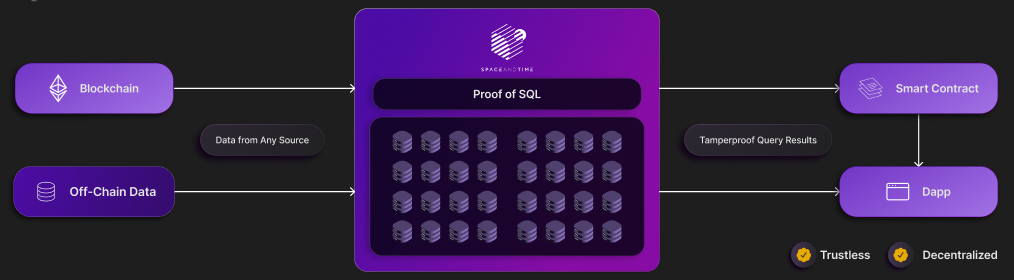
Space and Time (SXT) is a data blockchain built around a zero-knowledge proving system called Proof of SQL. The core idea is simple: any smart contract can query indexed blockchain data using SQL, and the result comes back with a cryptographic proof that the computation was performed correctly on untampered data.
The architecture works in three steps:
- Query. A smart contract sends a SQL query to SXT’s QueryRouter. The query can be anything expressible in SQL: aggregations, filters, joins, and so on across tables of indexed blockchain events. For example: “SELECT the total swap volume for this wallet address over the last 30 days.”
- Prove. The SXT network executes the query against its indexed data and generates a Proof of SQL, a ZK proof that the result is mathematically correct and that the underlying dataset has not been tampered with. No trust in any single node or operator is required.
- Callback. The verified result is delivered back to the requesting contract via a callback. The contract can then use that result in its business logic (adjusting a fee, updating a discount tier, gating access to a pool, etc.) with full confidence that the underlying data is correct.
No oracles. No offchain APIs. No manually maintained allowlists. The data is indexed from the blockchain, the computation is proven with zero-knowledge cryptography, and the result is delivered onchain. The entire flow is trustless and verifiable.
Bringing Verified Data into Uniswap v4 Hooks
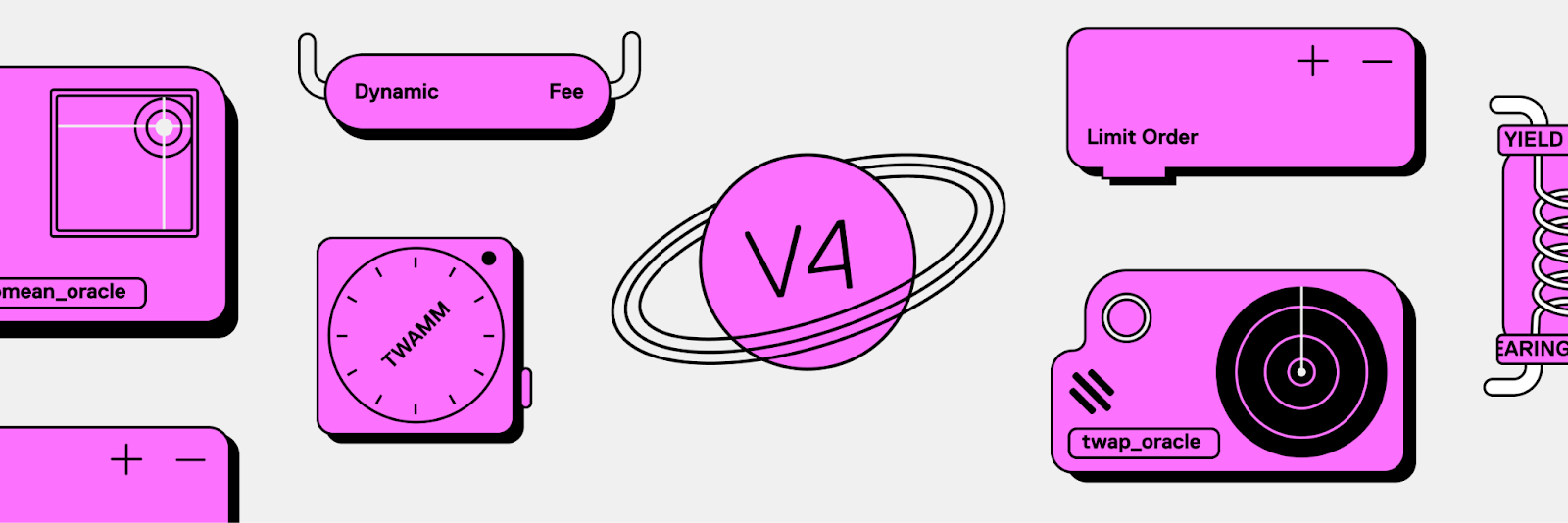
This architecture becomes especially powerful when combined with Uniswap v4’s hook system. Hooks are smart contracts that execute custom logic at key moments in a pool’s lifecycle, including before and after swaps, liquidity changes, and pool creation. They’re the mechanism through which dynamic fees are implemented in v4.
But hooks execute within a single transaction. They can see the current pool state and block data, but nothing historical. This is the exact constraint that Proof of SQL resolves.
By integrating SXT into a hook, the flow becomes:
How It Works Together
1. The hook contract (or a user’s frontend) sends a SQL query to SXT. For example: “What is this wallet’s 30-day trading volume?” or “How long has this address held LP positions?”
2. SXT executes the query against indexed blockchain data and returns the result with a cryptographic proof.
3. The hook’s callback function receives the verified result, maps it to a fee adjustment (e.g., “this wallet qualifies for a 20% discount”), and caches it onchain.
4. On the next swap, the hook reads the cached discount in its beforeSwap function and returns an adjusted fee to the Uniswap PoolManager.
The SQL query is the only thing a developer needs to customize. The query plumbing, callback wiring, proof verification, and hook adapter interface are handled by the infrastructure. You bring the condition (volume threshold, staking balance, token holding period, transaction count) and SXT’s Uniswap v4 hook templates handle the rest.
In Practice: The Uniswap v4 Hook Templates
Space and Time has released three ready-to-customize hook templates on chain.spaceandtime.io, each covering a different pattern for how discount eligibility is computed, stored, and applied at swap time.
Loyalty Discount. The simplest and most auditable pattern. A user checks their eligibility, SXT proves their onchain history, the hook caches a discount tier, and fees are adjusted on the next swap. Think of it like checking your frequent flyer status before booking a flight: you look up your tier, then the discount is applied at checkout. Because the discount is cached after verification, the swap itself is fast and cheap.
One-Click Intent. Collapses the eligibility check and the swap into a single transaction. The user submits one transaction, SXT computes the discount in the background, and the swap executes when the verified result comes back.
Discount Voucher. Users earn an NFT voucher based on proven activity and redeem it for discounted swaps. This makes the discount composable and transferable, which is useful if you want discounts to be tradeable or usable across multiple pools.
Each template ships as a complete Foundry project with documentation, example SQL queries, and a security checklist covering callback spoofing, replay attacks, stale discount exploits, and voucher misuse.
The Query Workbench at chain.spaceandtime.io lets developers write and test their SQL queries against live indexed blockchain data, then export the proof plan their hook contract requires. The full technical walkthrough, including contract architecture and deployment guidance, is available here
What’s Coming Next
The current implementations are the first wave. Most hooks today adjust fees based on a single variable, be that volume, volatility, or holding period. The next generation will combine multiple signals: a fee that considers both market conditions and user behavior simultaneously, or one that factors in cross-chain activity and liquidity positions across multiple protocols.
We’re also seeing the early convergence of AI and onchain fee logic. Offchain models could analyze complex patterns like trader behavior clustering, liquidity flow predictions, and cross-protocol risk, then generate fee recommendations that are verified and applied onchain through the same Proof of SQL pipeline. The boundary between offchain intelligence and onchain execution is blurring, and dynamic fees are one of the first places where that convergence has real economic impact.
More broadly, the shift to dynamic fees reflects DeFi’s maturation from a bootstrapping phase into a competitive market. In 2025, DeFi protocols tripled the share of revenue returned to token holders. Perpetual DEXs, spot exchanges, and lending markets are all competing aggressively on execution quality and pricing. The protocols that win will be the ones that price their services intelligently: not with a single number that ignores reality, but with systems that adapt to it.
Fixed fees were a necessary starting point. Dynamic fees, powered by verifiable data, are where DeFi goes from here. Start building with dynamic fees with Space and Time here.
