
Cross-Chain Analytics: Unified View Across Chains Without New Trust Assumptions
The multi-chain reality is not a future scenario; it is the present. Capital regularly moves between Ethereum, its L2s, Solana, Sui, and a growing list of specialized chains. Users hold assets across multiple wallets on multiple networks. Protocols deploy on several chains simultaneously. And yet, obtaining a unified, accurate view of activity across these chains remains one of the hardest infrastructure problems in the space.
The Problem with Current Cross-Chain Data Approaches
Most teams that need cross-chain data today rely on one of two approaches. The first is running separate indexing infrastructure for each chain and stitching the results together in a centralized backend. This works for internal dashboards and analytics, but it is operationally expensive, fragile, and produces results that carry no cryptographic guarantee of correctness. If any part of the pipeline is compromised, is misconfigured, or experiences downtime, the data can be silently wrong.
The second approach uses cross-chain messaging protocols or bridges to relay data between chains. These solutions have enabled meaningful interoperability for asset transfers and message passing. However, they introduce new trust assumptions: you are trusting the bridge operators, the relayer set, or the light client implementation to accurately convey state from one chain to another. The history of bridge exploits demonstrates that these trust assumptions are not without risks.
For analytics, specifically, neither approach is satisfactory. Developers and protocols need to answer questions such as “What is the total TVL of a protocol across all its deployments?”, “How many unique wallets have interacted with a set of contracts across Ethereum, Base, and Arbitrum?” and “What is the cross-chain trading volume for a specific token over the last 90 days?” These are data questions, not message-passing questions, and they require a different kind of infrastructure.
What a Trustless Cross-Chain Data Layer Looks Like
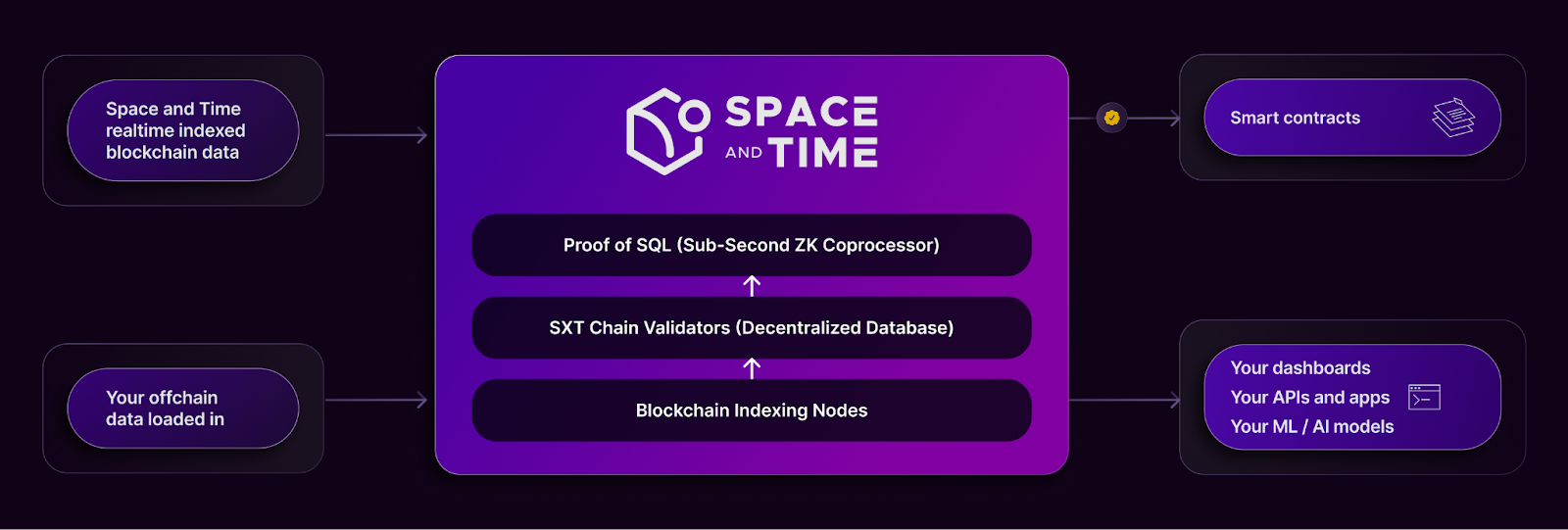
The ideal solution would index data from multiple chains into a single, queryable environment, allow developers to write queries that span chain boundaries, and attach a cryptographic proof to every result so that the answer can be consumed on any EVM chain without introducing new trust assumptions.
This is fundamentally different from a cross-chain bridge. A bridge moves state from chain A to chain B and requires you to trust the bridge. A verifiable cross-chain data layer enables one to query the state of chains A, B, and C from a neutral environment and proves the result to any chain that needs it. The proof replaces the trust assumption.
How Space and Time Enables Cross-Chain Analytics
Space and Time is designed from the ground up for this use case. SXT indexers collect data from major blockchains from the genesis block of each chain. This data is stored in relational tables within SXT's decentralized database, updated in real time as new blocks are produced.
Because all chain data lives in a single SQL-queryable environment, developers can write queries that join tables from different chains. For example, a query could join Ethereum DEX swap events with Polygon bridge transfer events and Sui token mint events to compute a cross-chain activity profile for a set of wallets. This is a standard SQL join operation, something that is trivial in traditional databases but has been extremely difficult in blockchain infrastructure.
The critical difference is what happens after the query executes. Proof of SQL generates a ZK proof that the query was computed correctly over data that has been secured by SXT's validator network. The validators have reached BFT consensus on cryptographic commitments for every table in the database, and the proof references these commitments. The result, along with the proof, can then be delivered to a smart contract on any EVM chain for onchain verification.
This means a smart contract on Ethereum can consume a verified result that incorporates data from (for example) Polygon, Sui, and Bitcoin without trusting any bridge, relayer, or oracle to have accurately conveyed that data. The trust model is the same as verifying any other ZK proof: one trusts the mathematics of the proof system and the economic security of the validator set that signed the data commitments.
Examples of What This Unlocks
Unified Protocol Analytics: Protocols deployed on multiple chains can obtain a single, verified view of their total activity, TVL, and user base. This is valuable not just for internal analytics but for governance decisions, treasury management, and investor reporting.
Cross-Chain DeFi Instruments: Financial instruments that reference cross-chain data, such as a derivative priced on trading activity across multiple DEXs on different chains, become feasible when the data can be queried and proven in a single operation.
Cross-Chain Identity and Reputation: User reputation systems that aggregate onchain behavior across multiple chains, including transaction volume, protocol participation, and governance activity, can produce verified reputation scores that smart contracts on any chain can consume.
Regulatory Compliance: Compliance monitoring that spans multiple chains can produce auditable, cryptographically verified reports rather than relying on screenshots and manual data exports.
Proving, Not Bridging
The core insight is that for data and analytics use cases, proving is a fundamentally better paradigm than bridging. A bridge asks you to trust a set of operators to correctly move a piece of state. A ZK-proven query allows you to verify the result yourself. The difference is especially important as the number of chains grows; bridging between N chains requires N-squared bridge connections, each with its own trust assumptions. A verifiable data layer requires only that each chain is indexed into a single queryable store, and any result can be proven to any consumer.
For developers and protocols operating in a multi-chain world, Space and time infrastructure turns fragmented chain data into a unified, trustworthy resource. Get in touch with us here to start building together.
Cross-chain analytics starts with indexing. See how the top blockchain indexing tools compare.
